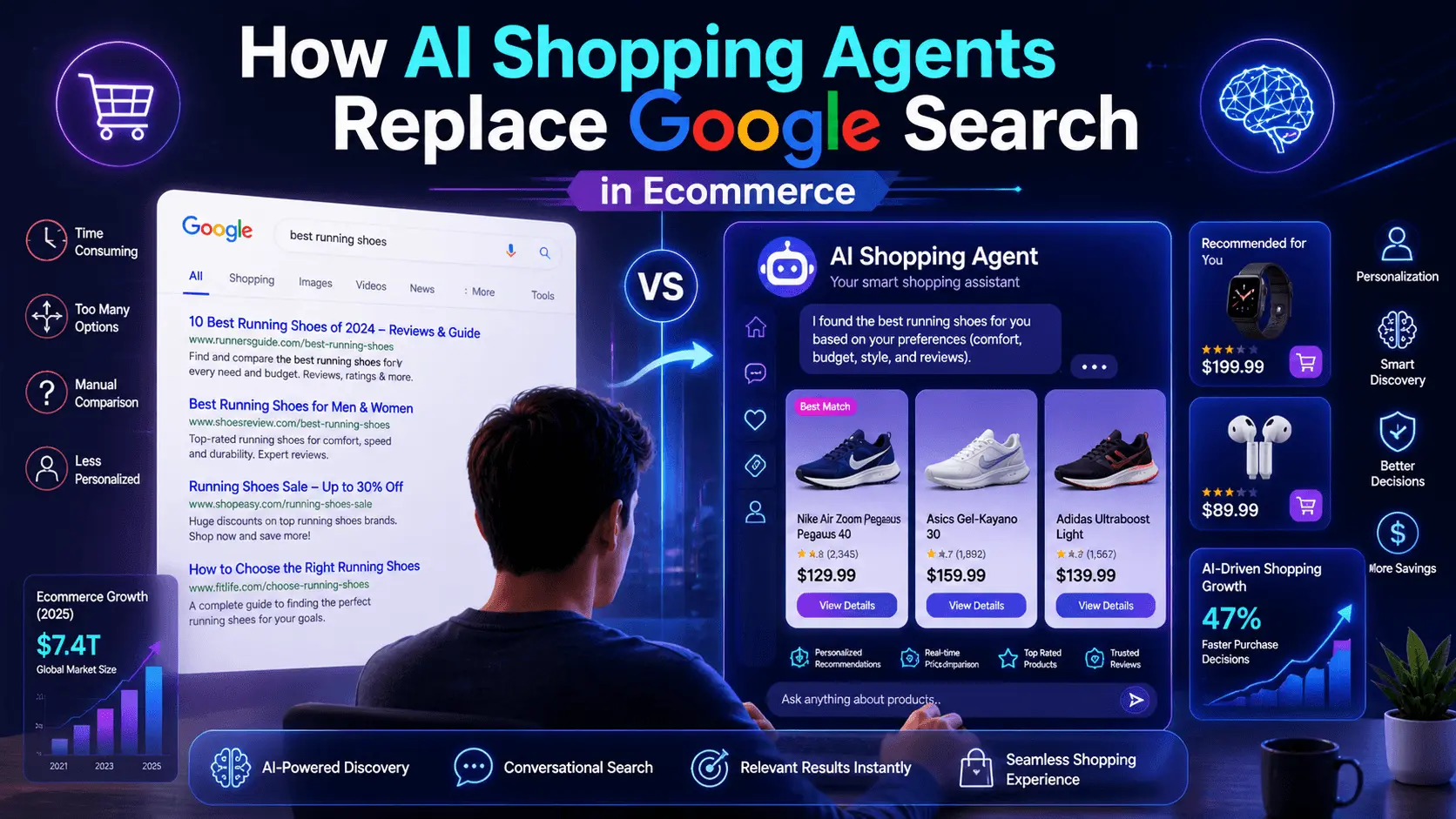

Remember the last time you searched for something on Google? You typed a few words in, peered through a wall of blue links, explored a handful of pages, compared products by hand, and finally bought something? Wish you could go back?
Nowadays, we don’t simply search. We inquire. People feed entire questions into ChatGPT, Perplexity, or AI-based shopping solutions and receive immediate, tailored responses. The AI shopping agents are at the forefront of this revolution, and they are moving quickly.
Global ecommerce is growing fast. By 2025, online retail sales are expected to reach around $7.4 trillion worldwide, showing how quickly digital shopping is expanding. As there are billions of products with thousands of new buyers entering the market daily, traditional search methods are no longer viable. They are lengthy, irrelevant, and downright annoying.
The shopping agents powered by AI for ecommerce are here to fix this issue. With these one-click shopping agents, you can simply tell them what you want, they keep track of your preferences, compare in seconds, and direct you to hit the checkout button. They are not helpful anymore. They are revolutionizing discovery.
In this blog, we will explore together what AI shopping agents are, how they work, why they are taking Google search by storm, and what your ecommerce business needs to do today to stay ahead.
Key Takeaways
- AI shopping agents are fundamentally transforming how people discover and buy products online.
- They offer faster, smarter, and deeply personalized shopping experiences compared to traditional search.
- Google search is rapidly losing ground as the primary product discovery tool.
- Businesses must shift from traditional SEO to AI-driven optimization (AIO) to stay visible.
- The future of ecommerce discovery is conversational, automated, and agent-powered.
- Agentic commerce is projected to contribute over $190 billion in ecommerce revenue by 2030.
What Are AI Shopping Agents?
AI shopping agents, shopping assistants powered by artificial intelligence, are intelligent computer programs that automatically browse, compare, and buy products and services using natural language–based conversations. Rather than type queries like “best running shoes under $100” into a search engine and then sift through hundreds of ads and links, the shopper simply asks: I need lightweight running shoes to train in every day, my price limit is $100, I have flat feet, what should I buy?
The AI agent fully understands the question budget, use case, and physical need and instantly provides an accurate set of recommendations.
Types of AI Shopping Agents
- AI chatbots embedded in online stores (e.g., Shopify Inbox with AI, Tidio, Gorgias)
- Conversational AI assistants such as ChatGPT Shopping, Google Gemini, and Perplexity AI
- Virtual shopping assistants inside apps like Amazon Rufus and Walmart’s AI assistant
- Autonomous AI agents that can browse, compare, and purchase on a user’s behalf
How Do They Work?
AI shopping agents rely on three core technologies:
- Natural Language Processing (NLP): Allows the agent to understand human language the way we naturally speak or write.
- Machine Learning (ML): Helps the agent learn from past behavior, preferences, and patterns to improve recommendations over time.
- Personalization Engines: Tailor every response to the individual user based on their history, location, device, and expressed needs.
Research shows that AI shopping agents are driving purchase decisions up to 47% faster than traditional browsing methods. That kind of speed is hard to ignore.
How Ecommerce Discovery Worked Before AI
To understand why AI shopping agents are such a big deal, it helps to look back at how product discovery used to work and why it frustrated so many shoppers.
The Traditional Google Search Journey
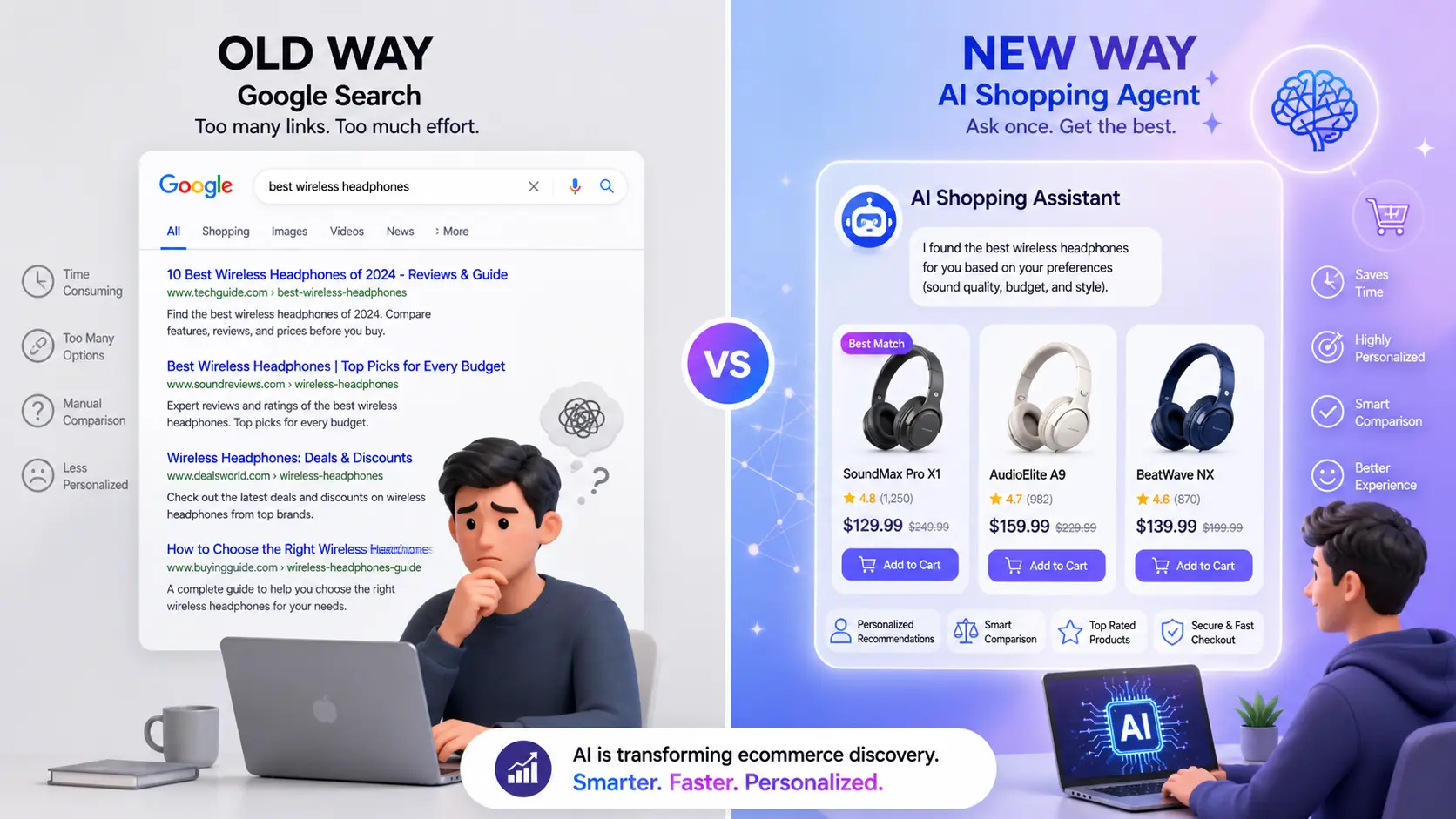
- A shopper types keywords into Google: “best wireless headphones 2024.”
- Google returns a mix of ads, review sites, comparison pages, and brand websites
- The shopper opens multiple tabs and starts reading reviews
- They visit two or three product pages across different stores
- They manually compare prices, features, and shipping times
- Finally, they decide or abandon the process entirely
This trip could easily take 20 to 30 minutes, and if they arrived without finding something, there were no assurances their purchase would be successful. About 47% of consumers expect a web page to load in 2 seconds or less, and many abandon sites that take longer. Just throw in the information dump of search results, and it is just plain surprising they didn’t walk away from the shopping cart altogether.
The Limitations Were Real
- Time-consuming: Too many steps between intent and purchase.
- Too many options: Google’s results overwhelm rather than guide.
- Lack of personalization: The same results appear for every user, regardless of their needs.
- No conversational context: Google cannot ask follow-up questions or refine based on nuance.
- Fragmented experience: Search, compare, and buy happened across multiple websites.
How AI Shopping Agents Are Changing Ecommerce Discovery
AI shopping agents for ecommerce have turned the discovery process on its head. Instead of a generic list, other people have already selected this isn’t Tops’ list of links, now the shopper gets a customized conversation that culminates with a confident buy decision.
A Conversational Shopping Experience
Think of a shopping BFF who has all the answers. She knows about every item in the world, takes your budget into account, remembers your every whim, and never gets tired of your questions. That’s just what a well-constructed AI shopping assistant will provide. You’ll be able to follow up in the same conversation, whittle down the products to what’s right for you, and receive direct, consistent answers.
Personalized Recommendations in Real Time
AI ecommerce discovery tools cut through data that Google just can’t see when performing a search, such as purchase history, navigation patterns, preferences, and even the rhythm of the seasons. People feel special when the recommendation seems baked just for them. According to studies,74% of online shopping is likely to be purchased by people.
Real-Time Comparison and Decision-Making
Instead of opening five browser tabs, a shopper with the AI agent can be given a real-time side-by-side comparison of the options based on whatever criterion is relevant- cost, life span, sustainability, or speed of delivery. The decision fatigue drops significantly.
Explosive Growth in AI-Driven Traffic
AI-driven traffic to ecommerce stores has seen explosive growth, with reports showing increases of over 4,700% between 2023 and 2025, highlighting a massive shift toward AI-powered product discovery.
Already, the According to the Adobe Digital Economy Index, referral traffic to U.S. retail websites from AI-powered sources grew by 393% year-over-year in Q1 2026. During the 2025 holiday season, AI-driven traffic surged even higher, increasing by 693%, showing how quickly AI is becoming a major driver of ecommerce discovery. Each month, more consumers are beginning their product search inside an AI tool, rather than a search engine.
Why AI Shopping Agents Are Replacing Google Search
And Google has built its dominance on the keyword. You give it words; it gives you links. For fifteen years, that was good enough. But ecommerce shoppers have become more demanding, more pressed for time, and more expecting of personalization. Google’s keyword model has begun to buckle under the strain.
Faster Answers, Less Friction
A shopper questions an AI agent, and they’re answered, not ten blue links to click through. The difference between the AI shopping agent and Google search comparison is that one gives you a destination, and the other gives you a set of directions with no end in sight.
Context-Aware Recommendations
AI agents have a sense of context that Google simply can not. If you tell it that you already own a Sony camera, it will take that into account and assume the lens you are asking for must be compatible with that camera. Google has no concept of this.
End-to-End Shopping in One Place
AI shopping agents can do everything from discovery to comparison to checkout in a single transaction. AI product recommendation tools are very well-integrated with payment systems, loyalty programs, and inventory management databases, so people can complete their purchase easily.
Growing Adoption Numbers
AI adoption is happening so fast that you cannot ignore it. Nearly 47% of online shoppers are expected to use AI-powered shopping agents by 2030, as AI assistants become more integrated into ecommerce platforms.
The global AI in ecommerce market is projected to grow from around $8.65 billion in 2025 to over $22.6 billion by 2032, driven by personalization, automation, and AI-driven discovery tools.
Interest in “AI agent” has surged significantly, with search demand more than tripling in the past year, reflecting rapid adoption of AI-driven tools across industries.
Comparison of AI Shopping Agents vs Google Search
Here is a clear, side-by-side breakdown of how these two discovery methods stack up:
| Feature | AI Shopping Agents | Google Search |
| Search Style | Conversational, natural language | Keyword-based queries |
| Personalization | Deep, real-time behavioral analysis | Limited, cookie-based |
| Product Discovery | Curated, intent-driven recommendations | List of links to browse manually |
| Purchase Flow | End-to-end: search to checkout | Redirects to separate store pages |
| Speed | Instant answers, no browsing needed | Multiple clicks required |
| Context Awareness | Remembers preferences mid-session | No session memory |
| Decision Support | Compares, filters, and recommends | The user must compare manually |
| Post-Purchase Help | Handles tracking, returns, and queries | Not applicable |
| Adoption Growth | ~39% CAGR, explosive growth | Mature, declining in product search |
Key Benefits of AI Shopping Agents for Ecommerce Businesses
1. Faster Product Discovery
Shoppers get what they are searching for in seconds, not minutes. Faster discovery here means lower drop-off and increased conversion from the beginning.
2. Better Personalization at Scale
AI recommendation tools are customizing shopping for every single user at the same time. No human team of agents could do that. According to some studies, 87% of companies that were using AI have significantly better capabilities to personalize than their former systems.
3. Higher Conversion Rates
For firms that have used artificial intelligence to discover additional revenues, they see a conversion rate increase that varies from 15% (poor implementation) to more than 100%, and the average revenue escalation following is recorded at 24%.
4. Reduced Decision Fatigue
When, instead of hundreds, a customer is suggested two or three perfect recommendations, they buy faster, more confidently, and, if they are window shopping, will buy less. Fewer cart abandonments, more sales:
5. Revenue and Sales Growth
Personalization enabled by AI generates up to 40% greater revenue for ecommerce companies. Revenue per visit, enabled by AI, increased by 84% between January and July 2025.
Challenges of AI Shopping Agents (And How to Overcome Them)
While powerful, AI shopping agents are by no means perfect. Below is a list of some of the most common problems encountered by ecommerce companies and shoppers, and how to solve them in practice:
Accuracy Issues in Recommendations
These are wonderful AI agents, agents that learn by watching, but if your data source is out-of-date or incomplete (the last time you updated your products was four months ago), then the agent can end up recommending all kinds of bad products that you don’t stock anymore, not stock yet, or are simply wrong. Not a big fix; Keep your products structured, up-to-date, and descriptive, because AI is only as good as its data.
Data Privacy Concerns
You will need the right data. Customers will need to provide you with info about themselves and their shopping habits. Be transparent and open about what data you’re using. Ensure your practices are GDPR, CCPA, and regional compliant. Make the user know what they are consenting to.
Bias in AI Decisions
Bias can also exist in the data used to train AI, as promotional items are influenced by the gender, location, and purchasing trends of previous buyers. AI recommendations can be monitored regularly so they are noticed and rectified before affecting the customer experience.
Trust and Transparency
Now, 74% of customer experience professionals say transparency about AI is more important than a requirement from consumers, a requirement from the government, or a requirement from the contact center. We simply want to know when we’re communicating with a person and when we’re not. When marked accurately, that’s never cause for concern
Real-World Examples of AI Shopping Agents
Amazon Rufus
Amazon introduced Rufus, an AI shopping assistant that lives inside the company’s app and website. Customers can ask Rufus for help finding items, getting recommendations and suggestions, and learning what to purchase for a particular use case. Since Amazon has so much data on products and customers’ purchase history, its results are very personalized. Customers’ interactions and click-through rates on AI-supported product pages have grown since the launch.
Walmart AI Assistant
Conversion therapy: Walmart built an AI-powered conversational agent into its website and app. Customers could now ask about products and receive personalized recommendations, make a purchase, and be transferred to a website, all within a chat, without ever leaving the conversation. Walmart has experienced significantly increased basket size and repeat purchase rates since the implementation.
Shopify AI Tools
Shopify’s Sidekick and AI (artificial intelligence) powered Inbox tools enable merchants to install intelligent shopping assistants on their store pages. Customers can be led to size guides, matching products, and transportation info using normal conversation, leading to lower CSRs and higher conversions.
Google Itself Is Pivoting
Even Google acknowledges change. Google AI Overviews and Search Generative Experience (SGE) are efforts to transition from a link provider to an answer provider. However, standalone AI ecommerce discovery tools are gaining momentum, and consumer behavior shows shoppers access ChatGPT, Perplexity, and dedicated AI shopping tools ahead of any search box.
How Ecommerce Businesses Should Adapt Right Now
If your ecommerce plan is still centered on Google keyword rankings, you are already lost. Here is how to adapt.
Optimize for AI Discovery (AIO), Not Just SEO
AI Optimization (AIO) refers to your product data being optimized so it reads easily, is believable, and maximized for any AI tool. Write product descriptions in simple, natural language: “Blue Denim Jacket – SKU 44921” becomes “A slim-fit denim jacket for casual everyday wear, available in sizes XS to XXL, machine washable”.
Use Structured Product Data
AI agents need structured data to retrieve product data. Use schema markup on every single product page (e.g., Product, Offer, Review schemas). Make sure your Google Merchant Center feed and product catalogue are always up to date. AI agents look for structured data first.
Focus on Conversational Content
Produce FAQ-style content, comparison pages, and buying guides that respond to questions that shoppers are asking. Producing content that resembles the natural language of the people will make it much easier for AI-based tools to get to your products.
Build AI-Friendly Product Descriptions
Make sure to have all the major attributes in your product fields. Material, size, purpose, compatible items, who it is for, who needs it, and what problem it solves. The more context you can provide with your product data, the easier it will be for an AI agent to recommend it to the optimal buyer.
The Future of Ecommerce Discovery: Agentic Commerce
We are to witness the start of an even greater transformation. The growth of agentic commerce, in which distinct AI agents shop autonomously on behalf of humans, will change the very definition of ecommerce.
AI-First Shopping Experiences
In the next few years, our AI agent will do much more than suggest products to us. They will be shopping for us in price negotiating, pushing the inventory, entering the discount coupons, paying, checking out, and even returning without the consumers exerting a finger. The entire experience will be intent-driven, not clicks-driven.
Autonomous Buying Decisions
Reorders will be made automatically or semi-automatically for orders of consumer goods, household items, groceries, and other consumables regularly. Consumers will just have to approve it or customize the order. Similar technologies are starting to be used now with Amazon Subscribe & Save and integrations with smart home technology.
Market Growth That Demands Attention
The market for AI agents in ecommerce is growing at a rapid pace, with a projected CAGR of around 35% to 40%. Agentic commerce is expected to influence over $150–$200 billion in ecommerce revenue by 2030. Businesses that adapt early will be in the best position to capture this massive growth opportunity.
Practical Tips for Startups and Ecommerce Brands
Start With a Conversational AI Chatbot
- Platforms like Tidio, Gorgias, or Shopify Inbox let you deploy AI chatbots without heavy development investment.
- Start by answering the top 20 questions your customers ask, and use your support tickets as a script.
Invest in Personalization Tools
- Tools like Klaviyo, Rebuy, or LimeSpot use AI to personalize product recommendations across email, SMS, and your storefront.
- Even small personalization improvements (like showing recently viewed items) measurably reduce bounce rates.
Shift Focus to User Intent, Not Just Keywords
- Map your SEO strategy to questions, not just phrases. Think: “What shoes are best for standing all day?” not just “comfortable work shoes.”
- Use tools like AlsoAsked, AnswerThePublic, or ChatGPT itself to identify the questions your customers are actually asking.
Test AI-Driven Shopping Funnels
- A/B test pages with conversational AI elements (chat widgets, guided product finders) against standard product pages.
- Measure add-to-cart rate, session duration, and conversion rate. The data will tell you what works for your audience.
Common Mistakes Ecommerce Businesses Make
- Ignoring AI trends entirely: Brands that dismiss agentic commerce as hype are already losing ground to competitors who are experimenting now.
- Over-relying on SEO alone: Traditional SEO is still valuable, but it is no longer sufficient on its own. A multi-channel discovery strategy is essential.
- Not adapting product data for AI: Poor product descriptions, missing attributes, and incomplete catalog data make your products invisible to AI agents.
- Neglecting post-purchase experience: AI agents handle returns, tracking, and reorders. If your post-purchase flow is broken, AI will surface that problem to more people, faster.
- Treating AI as a one-time project: AI optimization is ongoing. Models update, shopper behavior shifts, and your data must keep pace.
Conclusion: The Future of Shopping Is Already Here
Moving away from Google search to AI shopping agents isn’t speculation. It’s happening today, faster than hardly anybody expected two years ago. Ecommerce traffic generated by AI is booming in the hundreds of percent year over year. Customers are clicking rather than searching. And the companies getting it are already outpacing those that don’t.
AI shopping agents for ecommerce are not replacing customers’ inspiration, storytelling, or great products. They are changing that front door through which we engage shoppers. If your front door is not AI-readable, personalized, and conversational, fewer and fewer shoppers will ever see it.
Firms that get ahead of this by organizing their product data, fine-tuning for conversational discovery, and bringing AI into the customer’s experience now will be the ones who succeed as agentic commerce goes from trend to norm.
The question is not whether AI shopping agents will replace Google search for product discovery. The question is: when your customer asks an AI agent for a recommendation, will your product be the answer?
Frequently Asked Questions (FAQs)
1. What exactly is an AI shopping agent?
An AI shopping agent is an intelligent tool that uses natural language processing and machine learning to help shoppers find, compare, and purchase products through conversational interactions, rather than keyword-based search queries.
2. How are AI shopping agents different from traditional search engines?
Unlike Google, AI shopping agents understand full context, remember user preferences within a session, provide curated recommendations, and can guide shoppers from discovery all the way through to checkout in a single conversation.
3. Are AI shopping agents safe to use for online purchases?
Yes, when built by reputable platforms. Look for agents that are transparent about data use, comply with privacy regulations like GDPR and CCPA, and do not store sensitive payment data beyond what is necessary for the transaction.
4. How can a small ecommerce store benefit from AI shopping agents?
Small stores can use affordable tools like Tidio, Shopify Inbox, or Rebuy to deploy AI chatbots and recommendation engines, improving conversion rates and customer experience without requiring a large development team or budget.
5. Will AI shopping agents eventually replace human customer support?
AI agents will automate a large portion of routine support queries, but human agents remain essential for complex issues, emotional situations, and high-stakes decisions. The best strategy combines AI efficiency with human empathy.
6. How should ecommerce businesses optimize their stores for AI discovery?
Focus on structured product data, conversational product descriptions, schema markup, FAQ-style content pages, and regular catalog updates. The more context and clarity your data provides, the more visible your products become to AI agents.