
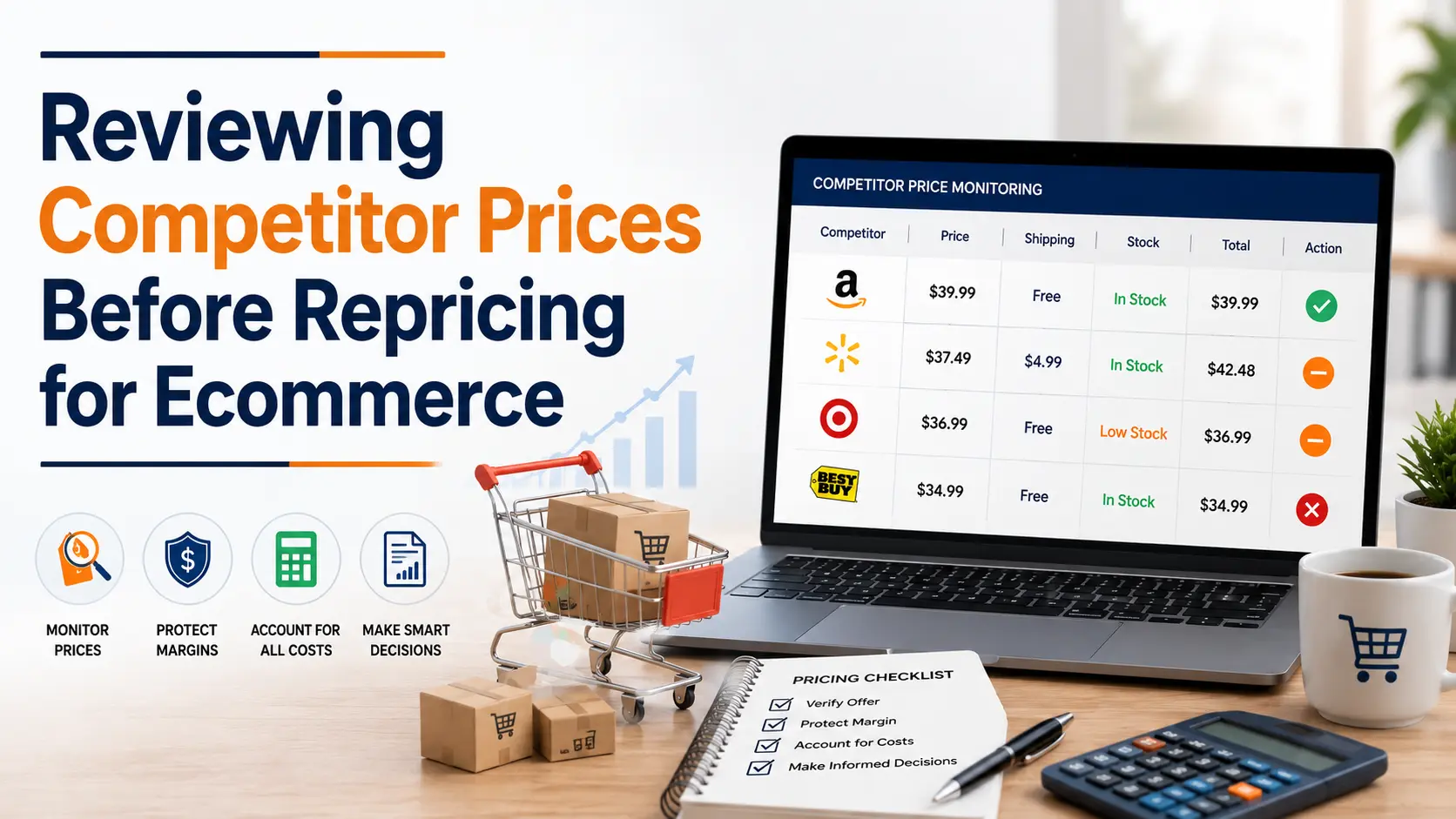

A lower price from the competition also triggers a strong impulse to move against it immediately. Matching the price might protect one sale, but it can also turn pricing into an uncontrolled margin leak. In a highly dynamic environment like e-commerce, this can snowball quickly.
Key Takeaways
- Review competitor prices before automating repricing decisions.
- Not every lower competitor price deserves a response.
- Define a safe pricing floor based on total variable costs.
- Separate truly comparable products from similar-looking offers.
- Ignore out-of-stock, coupon-only, and clearance price signals.
- Use recommendation mode before enabling automatic repricing.
- Add stop conditions to prevent margin-damaging price wars.
- Track profitability, not just sales volume, after price changes.
- Maintain a decision log for consistent pricing reviews.
- Strong pricing systems prioritize disciplined decision-making over speed.
Before a Shopify, WooCommerce, or marketplace seller adds repricing automation, the team needs to review rules that decide when a competitor price is relevant, when it should be ignored, and when it requires approval. That is especially true for lean stores where the same person may watch ads, suppliers, coupons, and product margins. Useful pricing systems do not stem from automation.
They instead begin with a small set of rules that turn price observations into decisions: verify the offer, protect contribution, account for channel costs, and leave a record.
Why competitor price review should come before repricing automation
Repricing automation is powerful when the inputs are clean, and the rules are clear. It is risky when the team has not defined what constitutes a valid price signal. A competitor page can show a sale price, member-only discount, bundle, damaged-box item, marketplace listing, or out-of-stock offer. Those are different commercial situations, even if they all look like a lower price at first glance.
If an ecommerce store treats every lower number as a price to match, the system will reward noisy behavior. The store may lower prices for offers that are not comparable, copy a temporary clearance event, or undercut itself on products where margin was already thin. A price review workflow gives the team a filter before any tool, app, or spreadsheet recommendation reaches the live storefront.
The goal is not to slow every decision. The goal is to make routine decisions easy and risky decisions visible. Once those rules exist, automation can support the process instead of defining it by accident.
Start with pricing decisions, not competitor price data
Many stores begin by collecting competitor URLs. That is useful, but it is not the same as building a pricing system. The better starting question is: what decision should this data help us make?
Define the role of each product
A hero product, add-on item, clearance SKU, private-label product, and supplier-limited product should not always follow the same repricing rule. Some products earn margin directly. Others create bundles, support repeat orders, or protect a category position. Before matching a competitor, the team should know whether the product is meant to win volume, protect contribution, clear inventory, or hold a premium position.
Set a minimum contribution rule
A margin percentage alone can be misleading. A product may show acceptable gross margin but still fail after shipping subsidy, payment fees, returns allowance, packaging, marketplace commission, and paid acquisition are included. A practical rule should define the lowest acceptable contribution for the product and channel.
For example, a direct Shopify order may have a different safe floor than an Amazon or eBay order because channel fees and fulfillment expectations differ. A seller should not ask, ‘Can we match $39?’ until the team knows whether $39 still protects the intended contribution after all variable costs.
Separate matched products from similar products
A competitor listing is useful only when the offer is truly comparable. Size, color, model year, warranty, condition, bundle contents, shipping promise, return window, and stock status can all change the decision. A cheaper product with no warranty or slower shipping is not always the same offer.
Five competitor price signals that should not trigger an automatic match
The easiest way to protect pricing discipline is to define the signals that should be reviewed or ignored before anyone changes the store price.
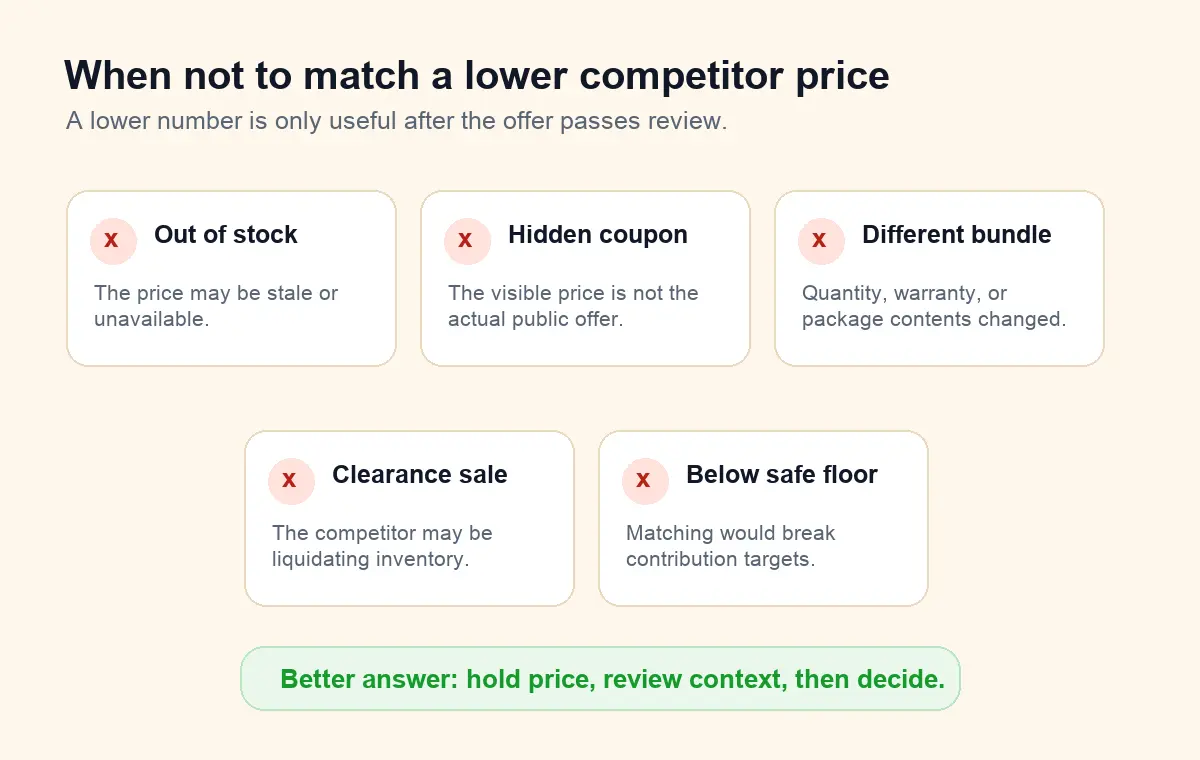
- Out-of-stock offers. If the competitor cannot ship, the lower price may be a stale signal rather than a market price.
- Membership or coupon-only prices. A public product page may hide the real condition behind a login, code, or loyalty discount.
- Bundles and multipacks. A lower unit price may not apply to the same quantity or package.
- Clearance events. A competitor may be liquidating inventory, not setting a sustainable price.
- Below-floor prices. If matching would break the contribution rule, the right action may be to hold price, adjust ads, or review supplier cost instead.
A margin-safe ecommerce price review workflow
A review workflow does not need to be complicated. It needs to be consistent enough that the team can repeat it under pressure.
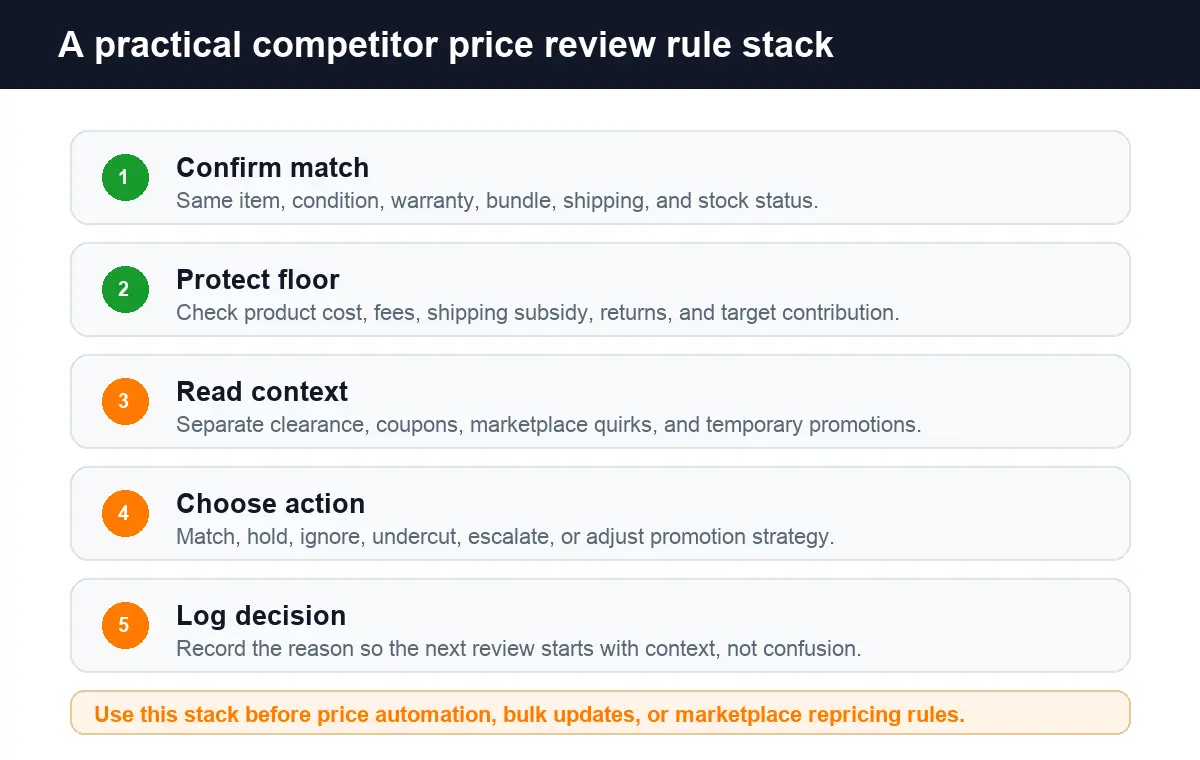
- Capture the observation. Save the competitor URL, observed price, timestamp, product match, and screenshot or note where possible.
- Normalize the offer. Check shipping, stock status, coupons, bundles, warranty, condition, and marketplace seller terms.
- Calculate the safe floor. Include product cost, channel fees, shipping subsidy, returns allowance, packaging, and any paid acquisition assumption.
- Choose a decision. Match, hold, undercut, ignore, escalate, or adjust the product’s promotion strategy.
- Record the reason. A short decision log prevents the same competitor signal from being debated again next week.
Use a calculator before turning the rule into automation
Before applying a repricing rule across a catalog, it helps to test the economics on one product. A free price war risk calculator can be used as a practical check for whether a competitor price match still protects margin after product cost, target margin, and competitor discount assumptions are considered. Disclosure: the calculator is provided by OmMarginshield, which works in this competitor-price monitoring and margin-guardrail workflow area.
The important point is not the calculator itself. The useful habit is to test the rule before scaling it. If a proposed match fails on one representative SKU, it will usually fail faster when repeated across many products.
Create review tiers before enabling price automation
A useful next step is to divide competitor-price observations into review tiers. This keeps the team from treating every alert with the same urgency.
Tier 1: no action needed
Some observations should be closed without a price change. Examples include out-of-stock competitors, unrelated bundles, prices that are still above your current price, and offers that do not affect a meaningful product. Closing these quickly keeps the review queue clean.
Tier 2: normal human review
Most valid competitor moves belong here. The price is live, the product is comparable, and a change might make sense, but the decision still depends on margin floor, channel context, promotion calendar, and inventory position. This is where recommendation mode is strongest.
Tier 3: escalation before any update
Escalation is useful when the competitor price is far below your safe floor, the SKU is high-volume, a supplier constraint may apply, or the signal conflicts with another commercial priority. These cases should not be buried inside ordinary repricing activity.
How to use Shopify repricing automation without starting a margin race
Once review rules are clear, automation can help with the repetitive parts of the process. The safer path is to start with recommendations, not automatic price writes.
Start in recommendation mode
Recommendation mode lets the system surface possible changes while a person still approves the decision. This is useful during the first weeks of a new workflow because it reveals which competitors create useful signals and which ones create noise.
Give every rule a stop condition
A repricing rule should know when not to act. Examples include ‘do not go below the safe floor,’ ‘do not respond to out-of-stock offers,’ ‘do not change price during a scheduled promotion,’ and ‘escalate if the observed competitor price drops more than a set percentage.’ Stop conditions are what keep automation from becoming a race to the bottom.
Review exceptions before prices update
The most valuable alerts are often the exceptions: a major competitor suddenly discounts, a supplier cost changes, a product falls below contribution, or a high-volume SKU receives conflicting signals. Those cases should go to a review queue instead of being treated as ordinary pricing events.
What to measure after changing price
A price change should be judged by more than whether sales increased. A lower price can raise conversion while reducing contribution, attracting lower-quality orders, or making advertising less efficient. The review process should include after-the-fact checks.
- Contribution dollars per order, not only gross margin percentage.
- Conversion rate on the affected product page.
- Ad cost per profitable order if paid traffic is involved.
- Inventory velocity and stockout risk.
- Return rate, support burden, and order quality.
- Whether the competitor price was temporary or durable.
Conclusion: better pricing systems leverage deliberation and make slower decisions faster
The strongest ecommerce pricing teams are not the teams that match every competitor instantly. They are the teams that know which competitor signals are curated to deserve action and which ones should be ignored. Counterintuitively, that discipline makes pricing adjustments faster because the rules are already cemented before the next discount appears.
For small stores, the first version can be a spreadsheet and a simple review checklist. For larger catalogs, the same logic can become a recommendation workflow with margin guardrails, approval history, and carefully limited automation. Either way, the operating principle is the same: competitor prices are considerations laden with nuance, not gospel.
If your store changed prices tomorrow, on what principle would you want every price change to pass before it reaches customers?
FAQs
1. Why should ecommerce stores review competitor prices before using repricing automation?
Competitor prices can reflect clearance sales, coupon discounts, bundles, or out-of-stock offers. Reviewing prices first helps ensure only relevant signals influence pricing decisions, preventing unnecessary margin erosion and reducing the risk of automated price wars.
2. What is a safe pricing floor in ecommerce?
A safe pricing floor is the lowest price a store can offer while maintaining acceptable contribution after accounting for product costs, shipping, payment processing fees, marketplace commissions, returns, packaging, and advertising expenses.
3. Which competitor price signals should not trigger automatic repricing?
Out-of-stock listings, member-only discounts, coupon-based offers, clearance sales, bundle deals, and prices below your profitability threshold should not automatically trigger repricing because they may not represent sustainable market pricing.
4. How can Shopify sellers avoid a margin-damaging price war?
Shopify sellers can avoid price wars by using recommendation-based repricing, setting minimum price floors, defining stop conditions, reviewing exceptions manually, and focusing on profitability rather than matching every competitor discount.
5. What metrics should be tracked after changing product prices?
Stores should monitor contribution dollars per order, conversion rates, advertising efficiency, inventory turnover, return rates, customer support workload, and whether competitor discounts are temporary or long-term to measure pricing success accurately.