
Your website is often the first interaction a customer has with your business. A slow page, a confusing layout, or a design that looks dated tells visitors something is wrong before they read a single word of your content. That single impression can decide whether someone stays, signs up, or leaves for a competitor.
This is why so many companies turn to web development agencies instead of building in-house or hiring a single freelancer. A dedicated team brings design, engineering, and strategy together under one roof, and that combination matters more now than it did even two years ago. Visitors expect fast load times, mobile-friendly layouts, and personalized experiences as standard, not as a bonus. Google’s “Milliseconds Make Millions” research found that the probability of a visitor bouncing increases by 32% when page load time rises from 1 second to 3 seconds. As load time extends to 5 seconds, bounce probability jumps by 90%, highlighting how even small performance delays can significantly impact user engagement and conversions.
Custom website development gives a business room to grow. A template can launch a site quickly, but it rarely scales cleanly with new features, integrations, or traffic spikes. Working with a professional web development company means the architecture, code, and design are built around your specific business goals rather than retrofitted around someone else’s template.
This guide breaks down the top 10 web development agencies for custom website development, what each one does best, and how to pick the right partner for your next project.
Key Takeaways
- Custom development pays off in flexibility: a site built around your workflows scales better than one squeezed into a template.
- Agency pricing ranges from roughly $25 an hour for offshore teams to $150+ an hour for specialist studios. The right price depends on project complexity, not agency size.
- AI-assisted personalization is no longer experimental. Adobe’s 2025 AI and Digital Trends research found 87% of organizations using AI-driven personalization had already seen measurable engagement gains.
- WordPress still powers roughly 42% of all websites, according to W3Techs, so agencies fluent in the platform can often shorten both timeline and cost for content-heavy projects.
- Performance and security are ranking factors now, not afterthoughts. Core Web Vitals and baseline encryption affect both conversions and search visibility.
- The cheapest quote is rarely the cheapest project. Unclear scope and post-launch support costs tend to add up fast once a contract is signed.
- A short discovery call reveals more about agency fit than a portfolio review alone. Ask about communication cadence and who owns the code and assets after launch.
How We Selected the Best Web Development Agencies
Picking the best web development agencies for this list meant going beyond marketing copy and star ratings. We weighed each company against the same set of practical criteria business buyers actually care about:
- Experience: years operating specifically in web development, not just general IT services.
- Portfolio quality: live client sites across a meaningful range of industries and project sizes.
- Technical expertise: depth across WordPress, Shopify, and custom stacks like React, Node.js, and Laravel.
- Client reviews: independent feedback from platforms such as Clutch, G2, and DesignRush.
- Industry specialization: proven work in ecommerce, SaaS, healthcare, or enterprise environments.
- Innovation: use of AI tooling, headless architecture, and progressive web app capability.
- Support and maintenance: clear post-launch service-level agreements and website maintenance services.
Top 10 Web Development Agencies Comparison
Use this table for a quick side-by-side view before reading the full profiles below.
| Agency | Founded | Headquarters | Best For | Key Technologies |
| Simform | 2010 | San Francisco, CA | Enterprise digital product engineering | React, Node.js, Cloud, AI/ML |
| Vention | 2002 | New York, NY | Dedicated teams for scaling startups | React, Python, Java, Cloud |
| ScienceSoft | 1989 | McKinney, TX | Enterprise & healthcare custom software | .NET, Java, PHP, AI |
| Rootstrap | 2011 | Los Angeles, CA | VC-backed startup product builds | React, Node.js, AI, Mobile |
| Chop Dawg | 2009 | Philadelphia, PA | Fixed-price web & app builds for startups | React Native, Node.js, AI |
| Plego Technologies | 2002 | Downers Grove, IL | Enterprise web apps & BI integration | .NET, Custom CMS, AI/ML |
| Coalition Technologies | 2009 | Los Angeles, CA | SEO-driven ecommerce web design | WordPress, Shopify, SEO tools |
| Lounge Lizard | 1998 | New York, NY | Branding-led custom website design | WordPress, Laravel, Custom CMS |
| Clay | 2016 | San Francisco, CA | Premium UX-led sites for funded brands | Custom front-end, Design systems |
| Baunfire | 2001 | San Jose, CA | High-end B2B SaaS marketing sites | WordPress, Custom front-end |
Top 10 Web Development Agencies for Custom Website Development
1. Simform
Simform is a digital product engineering company that started in Ahmedabad, India, in 2010 and has grown into a global team of more than 1,000 engineers, with a US headquarters in San Francisco. The agency works across the full software lifecycle, from web and mobile app development to cloud migration, DevOps, and AI/ML integration. Simform’s client list ranges from venture-backed startups to Fortune 500 companies, and its engagement model centers on embedding dedicated engineering pods directly into a client’s existing product team rather than handing over a finished product at the end.
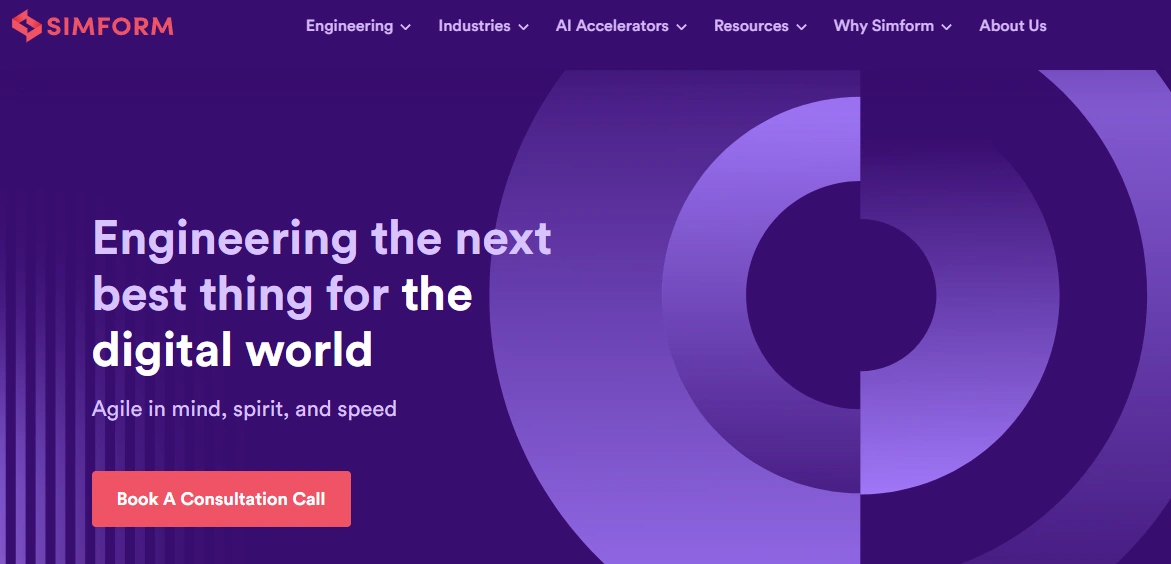
This co-engineering approach suits companies that want a long-term technical partner rather than a one-off build. Simform has built a reputation for handling complex, large-scale web platforms that need to integrate with existing enterprise systems, APIs, and data pipelines, which is why many of its case studies involve legacy modernization alongside new development.
Key Services: Custom web application development, cloud-native architecture, DevOps and CI/CD, AI/ML integration, UI/UX design, QA and testing.
Industry Expertise: Retail and ecommerce, healthcare, SaaS, fintech, logistics.
Best For: Mid-size to enterprise companies that need a dedicated engineering team for complex, long-term web platforms.
Pros:
- Large bench of senior engineers across multiple time zones
- Strong cloud and DevOps capability for scaling traffic-heavy sites
- Experience modernizing legacy systems alongside new development
Cons:
- Minimum project sizes can exclude smaller businesses
- Less suited to quick, low-budget marketing site builds
2. Vention
Vention has operated as a software engineering partner since 2002, completing a global rebrand in 2023 to match its growth. Headquartered in New York with more than 20 offices and over 3,000 engineers worldwide, Vention works with venture-backed startups and established enterprises that need dedicated development teams rather than a single contractor. The agency’s Dedicated Teams Model pairs in-house client engineers with Vention’s specialists, keeping institutional knowledge inside the client’s organization instead of locked inside an outside vendor.
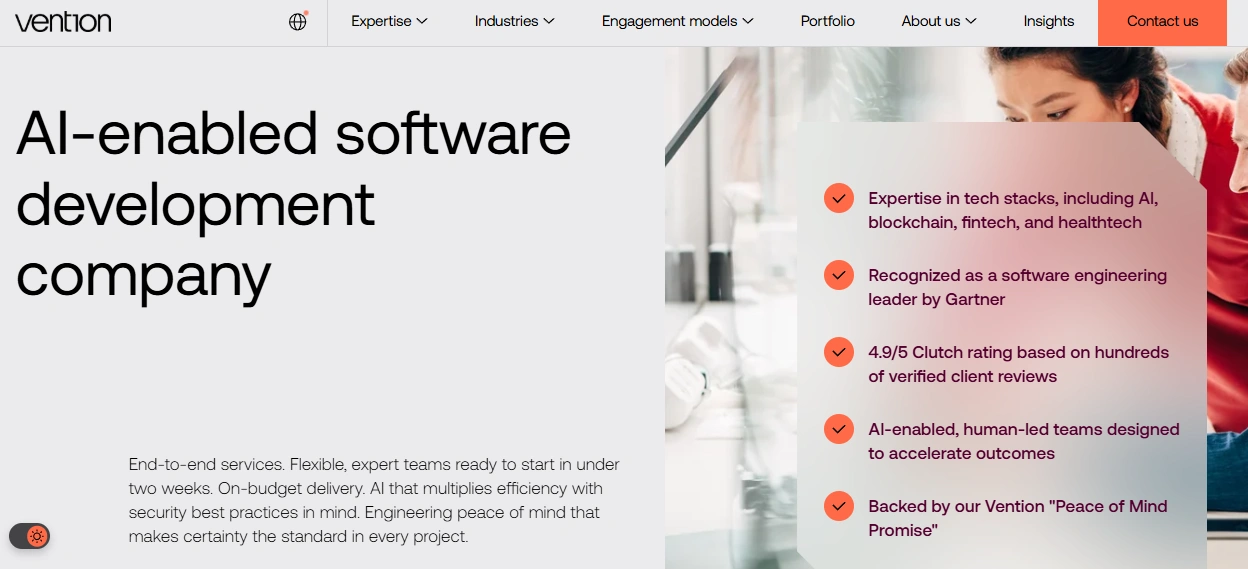
Vention covers custom web development, mobile app builds, and IT staff augmentation, and has leaned further into AI tooling through an internal AI Center of Excellence that trains its engineers on emerging frameworks. Its scale gives it flexibility to staff projects quickly, which matters for companies on tight funding timelines or aggressive product roadmaps.
Key Services: Custom web and mobile development, dedicated engineering teams, QA and testing, AI integration, software modernization.
Industry Expertise: SaaS, fintech, healthtech, consumer products, enterprise software.
Best For: Funded startups and scaling tech companies that need to add engineering capacity fast without sacrificing quality.
Pros:
- Massive engineering bench across 20+ global offices
- Flexible staffing for fast-growing teams
- Established track record spanning more than two decades
Cons:
- Size can mean less of a boutique, hands-on feel for smaller projects
- Project minimums favor mid-to-large budgets
3. ScienceSoft
ScienceSoft has been building software since 1989, making it one of the longest-running custom development firms on this list. Headquartered in McKinney, Texas, with delivery centers across Europe and the Middle East, the company employs more than 750 IT professionals and has completed thousands of projects for clients including IBM, Ford, and NASA.
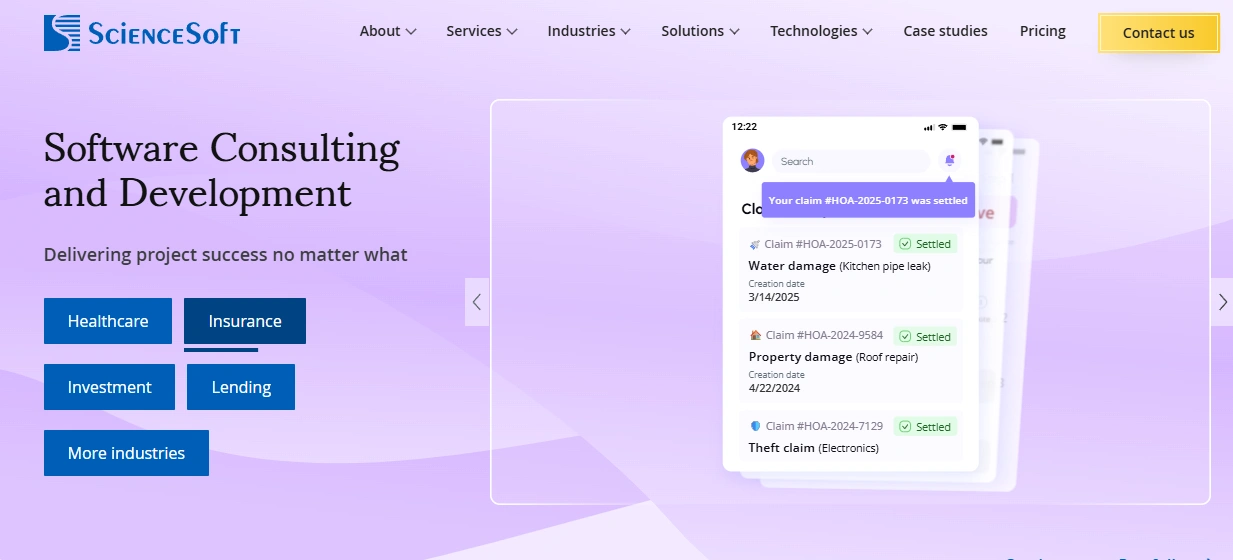
ScienceSoft’s web development practice covers everything from custom enterprise portals to ecommerce platforms, and the firm pairs its engineering work with business analysis and UX research up front, which reduces costly scope changes mid-project. Its healthcare and fintech specializations stand out, since both industries require strict compliance handling that not every web agency is equipped to manage correctly. ScienceSoft also runs ISO 27001-certified security practices, which matters for companies handling sensitive customer or patient data through their websites.
Key Services: Custom web application development, ecommerce development, UX/UI design, cloud migration, IT security consulting.
Industry Expertise: Healthcare, financial services, retail, manufacturing, logistics.
Best For: Enterprises in regulated industries that need compliant, secure custom web platforms.
Pros:
- 35+ years of delivery experience and ISO 27001 security certification
- Strong compliance handling for healthcare and finance
- Transparent, mid-range hourly pricing
Cons:
- Less focused on flashy creative or branding-led work
- Larger team structure can slow decisions on very small projects
4. Rootstrap
Rootstrap is a nearshore software agency founded in 2011 and based in Los Angeles, with development hubs in Argentina and Uruguay that keep its teams in convenient time zones for US clients. The company has helped launch more than 750 digital products and built a name for itself working with early-stage, VC-backed companies that need to move from idea to live product quickly.
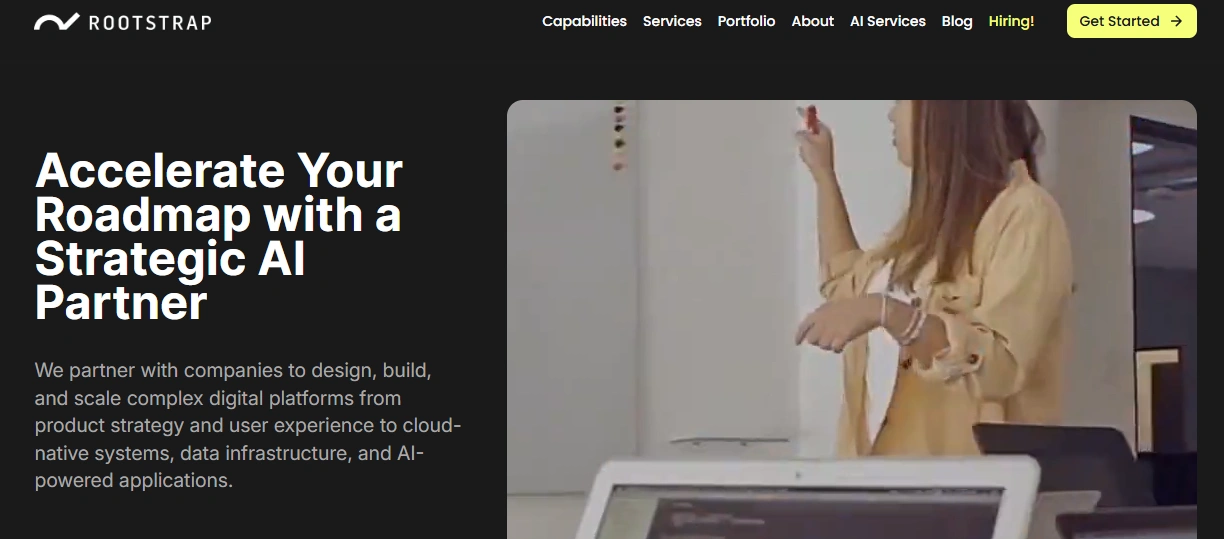
Rootstrap blends staff augmentation, placing senior engineers inside a client’s existing team, with full product studio engagements where it builds a website or app from scratch. Past projects include design sprint training for Google and revenue-focused redesign work for MasterClass, which shows a pattern of work that goes beyond pure code delivery into product strategy. Its AI and data engineering practice has expanded recently, giving clients a path to add machine learning features to custom web platforms without bringing in a second vendor.
Key Services: Custom web and mobile app development, staff augmentation, product strategy, AI and data engineering, UI/UX design.
Industry Expertise: Startups, media and entertainment, edtech, consumer apps, AI-driven products.
Best For: Early-stage and growth-stage startups that need a product-minded technical partner, not just code.
Pros:
- Strong startup pedigree with notable client outcomes
- Nearshore team keeps time zones aligned with US business hours
- Flexible engagement models, from staff augmentation to full builds
Cons:
- Premium hourly rates may stretch bootstrapped budgets
- Smaller team size than the larger firms on this list
5. Chop Dawg
Chop Dawg has an unusual origin story: founder Joshua Davidson started the company in 2009 at age 16, and it has since grown into a Philadelphia-based agency that has shipped more than 500 web and mobile apps for clients ranging from solo founders to NASA and the US Navy. The agency’s biggest differentiator is its pricing model. Instead of open-ended hourly billing, Chop Dawg offers fixed-rate monthly pricing with clear contracts, giving founders and small business owners predictable costs for a process that’s often unpredictable elsewhere.
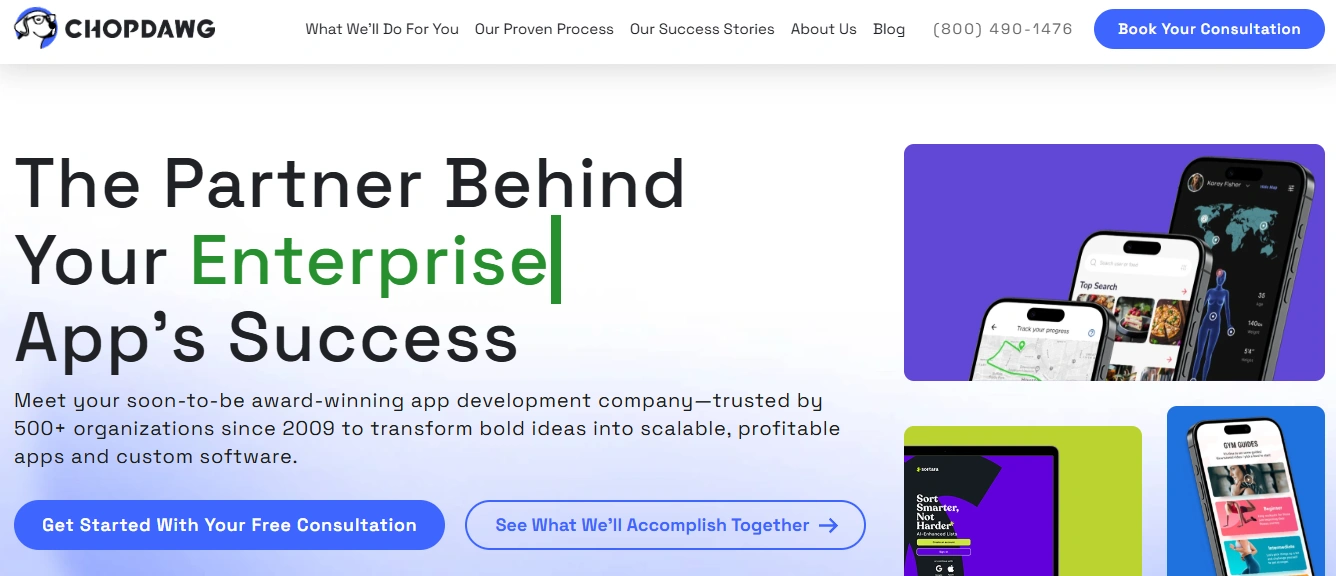
Its team spans the US, Brazil, and Pakistan, combining senior US-based strategy with cost-efficient offshore development capacity. Chop Dawg leans toward startups and growing businesses that need a website or web app built around a specific product idea, paired with ongoing support once the product launches rather than a one-time handoff.
Key Services: Custom web application development, mobile app development, MVP development, ongoing maintenance and support.
Industry Expertise: Startups, nonprofits, government agencies, healthcare, real estate.
Best For: Founders and small businesses that want transparent, fixed-rate pricing and long-term support.
Pros:
- Predictable fixed monthly pricing instead of hourly billing surprises
- 17 years of delivery history and 500+ shipped products
- Free initial consultation to scope projects before committing
Cons:
- Smaller team means less bandwidth for very large enterprise builds
- Less specialized in heavy ecommerce or headless commerce projects
6. Plego Technologies
Plego Technologies started in a small office in Westchester, Illinois, in 2002 and has since grown into a global firm with offices in Chicago, Houston, Milwaukee, Dubai, Riyadh, and Karachi. The agency’s core focus has stayed consistent over two decades: custom web application development, business intelligence, and systems integration for mid-size companies and Fortune 500 brands.
Past clients include Apple TV+, NBCUniversal, Google, and Samsung, signaling that despite a relatively lean team size, Plego has earned trust from technically demanding enterprise buyers. The firm’s combination of web development with business intelligence and ERP-to-web integration work makes it a strong fit for companies whose website needs to connect tightly with internal systems like inventory, CRM, or analytics platforms rather than function as a standalone marketing page.
Key Services: Custom web app development, business intelligence, systems integration, mobile app development, AI-driven solutions.
Industry Expertise: Media and entertainment, technology, consumer goods, manufacturing.
Best For: Mid-size to enterprise companies needing a website tightly integrated with internal business systems.
Pros:
- More than two decades of consistent enterprise client relationships
- Strong systems integration and BI capability alongside web development
- Global office footprint supports round-the-clock delivery
Cons:
- Smaller core team can mean longer queues during peak demand
- Marketing presence is less visible than larger competitors on this list
7. Coalition Technologies
Coalition Technologies was founded in Los Angeles in 2009 and has built its reputation primarily as an SEO and web design agency, with a workforce of more than 250 people split across Los Angeles, India, the Philippines, and Europe. The firm reports a 97% client retention rate, and its case studies frequently highlight measurable traffic and revenue gains alongside the visual redesign itself, since SEO strategy is built into every web project from the start rather than added afterward.
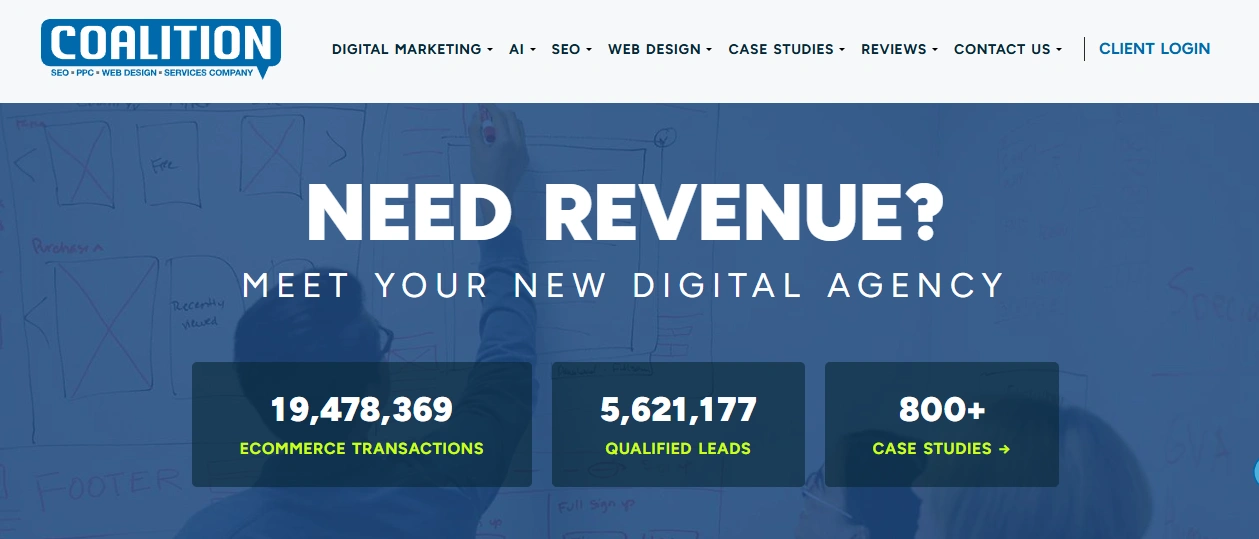
Coalition works heavily with WordPress and Shopify, making it a practical option for ecommerce brands and service businesses that need a website designed to convert search traffic into customers, not just look polished. Its combined design-and-marketing model appeals to companies that don’t want to manage a separate SEO vendor after their site launches.
Key Services: Website design and development, SEO, PPC management, ecommerce website development, conversion rate optimization.
Industry Expertise: Ecommerce, healthcare, legal, home services, professional services.
Best For: SMBs and ecommerce brands that want web design and SEO handled by one team.
Pros:
- SEO and design built together, reducing handoff friction between vendors
- Strong, well-documented client retention and satisfaction rates
- Deep WordPress and Shopify experience for ecommerce builds
Cons:
- Less suited to highly custom, code-heavy enterprise applications
- Heavier marketing focus may not fit companies wanting a pure dev shop
8. Lounge Lizard
Lounge Lizard has operated since 1998, making it one of the most established names on this list, with its New York headquarters and additional offices in Long Island, Washington D.C., Nashville, Miami, and Los Angeles. The agency built its identity around brand-led web design, blending strategy, visual identity, and development into single engagements rather than treating branding as a separate add-on.
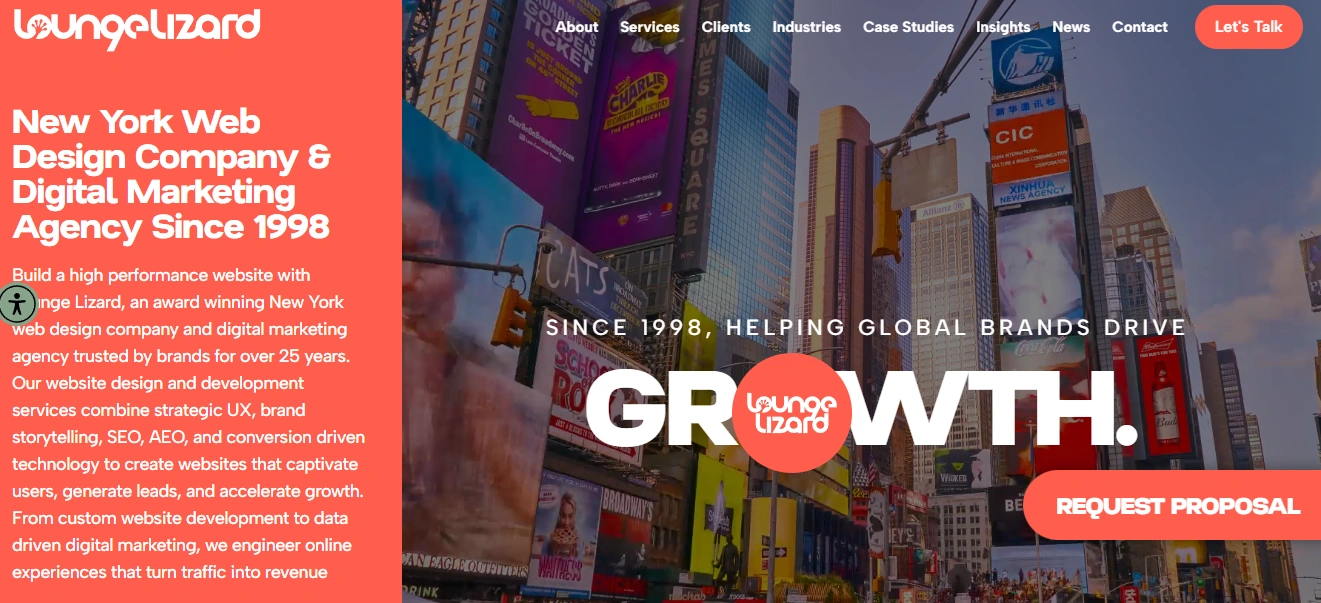
Lounge Lizard’s co-founder is a judge for the Webby Awards, which reflects the firm’s creative orientation, and its portfolio spans WordPress builds, Laravel-based custom applications, and mobile app development. The agency typically attracts businesses that want a distinctive visual identity alongside solid technical execution, especially companies refreshing an outdated site that no longer matches how the business has grown or repositioned itself.
Key Services: Website design and development, branding, digital marketing, SEO, ecommerce development.
Industry Expertise: Professional services, healthcare, hospitality, finance, consumer brands.
Best For: Established businesses wanting a brand-forward website redesign with marketing support attached.
Pros:
- Nearly three decades of brand and design credibility
- Multiple US office locations for in-person collaboration
- Combines branding, development, and digital marketing under one roof
Cons:
- Branding-first approach may add cost for clients who only need development
- Less specialized in heavy backend or enterprise application work
9. Clay
Clay is a UX design and brand experience agency headquartered in San Francisco, with a compact, senior-heavy team that has worked with Google, Amazon, Slack, Coinbase, and Sony. Rather than running large account teams with junior staff handling day-to-day execution, Clay structures projects around its co-founders and senior designers staying directly involved from strategy through launch.
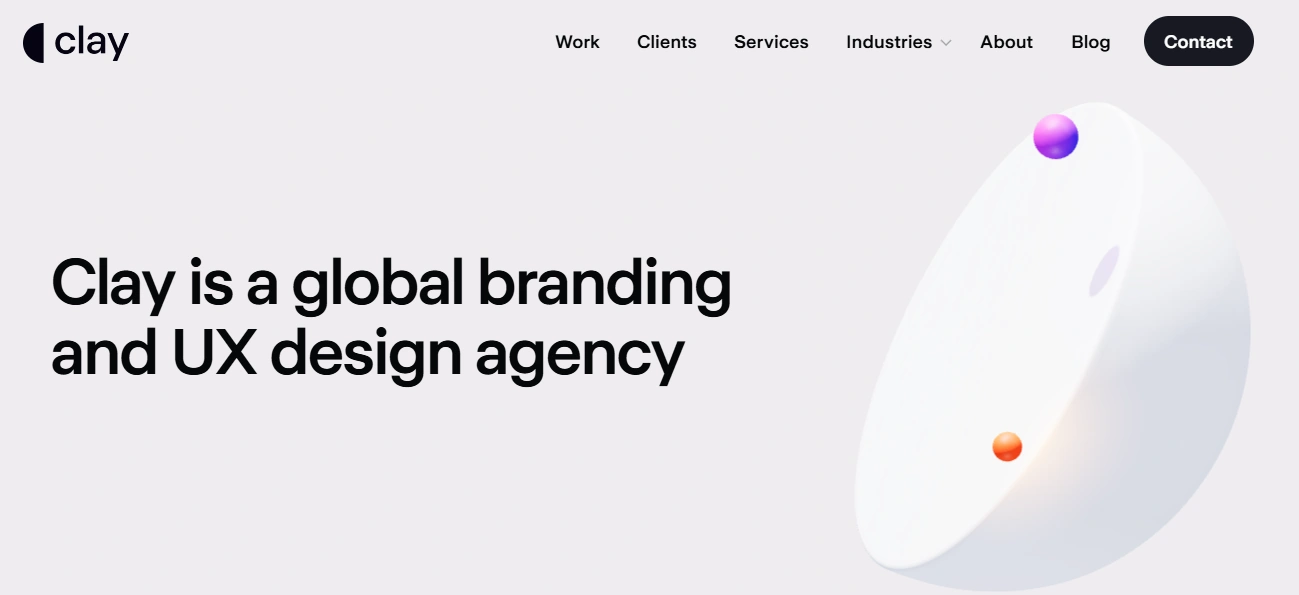
The agency operates as a remote-first company with team members across the US, Europe, and Southeast Asia, letting it serve global clients across time zones without sacrificing the senior-level attention that smaller, design-led agencies are known for. Clay’s web projects typically center on conversion-focused UI/UX design paired with front-end development, making it a strong choice for funded startups and established tech brands that want their website to look and feel as polished as the product it’s selling.
Key Services: UI/UX design, brand identity, web design and front-end development, design systems, product strategy.
Industry Expertise: SaaS, fintech, enterprise software, consumer tech.
Best For: Funded startups and tech brands prioritizing premium design and user experience over lowest-cost delivery.
Pros:
- Senior-level designers stay involved throughout the project, not just at kickoff
- Proven work with major brands like Google, Amazon, and Slack
- Strong design systems work supports consistent scaling across products
Cons:
- Smaller team size limits capacity for very large, multi-track projects
- Premium positioning means higher costs than mid-market alternatives
10. Baunfire
Baunfire is a Silicon Valley digital agency founded in 2001 and based in downtown San Jose, with a focused specialty in high-end marketing websites for B2B technology companies, venture capital firms, and funded startups. Clients include Google, Nike, Norwest Venture Partners, and Sapphire Ventures, and the agency’s five-step process discover, strategize, execute, launch, evolve emphasizes research-led discovery before any design work begins.
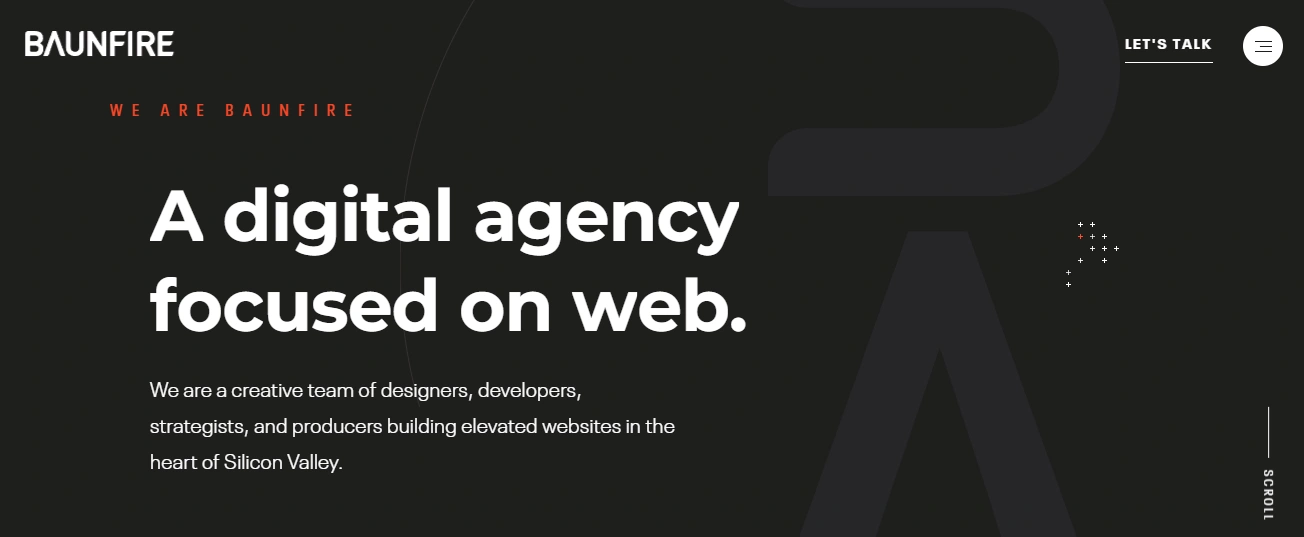
Baunfire keeps its team intentionally lean, which lets its designers, developers, strategists, and producers stay closely involved on every project instead of routing work through layers of account management. The agency typically works with WordPress as a content management foundation, paired with custom front-end development for visual polish, and its pricing sits at the premium end of the market, reflecting a boutique approach rather than high-volume output.
Key Services: B2B marketing website design, UX/UI strategy, front-end development, brand identity.
Industry Expertise: B2B technology, venture capital, SaaS, enterprise software.
Best For: B2B tech companies and VC-backed startups wanting a polished, high-performance marketing website.
Pros:
- Deep specialization in B2B tech and VC-backed client websites
- Lean team keeps senior talent close to every project
- Structured five-step process supports predictable timelines
Cons:
- High minimum project size excludes smaller budgets
- Narrower focus on marketing sites rather than complex web applications
Web Development Trends Shaping Custom Websites
Web development looks different from even three years ago, mostly because the baseline for “good enough” has moved. These are the trends showing up most often in current custom website development services:
AI-powered websites. Generative AI now touches nearly every stage of a build, from content drafts to layout suggestions to automated testing. According to Gartner, by 2026 more than 80% of enterprises will have used generative AI APIs, foundation models, or deployed GenAI-enabled applications in production environments, up from less than 5% in 2023. This rapid adoption has transformed AI from an experimental initiative into a core business investment, making AI integration a standard component of modern digital transformation and web development projects.
AI is rapidly transforming website development. HubSpot reports that 58% of web designers now use AI to generate images and other visual assets, while half leverage AI to create complete webpage designs, making AI an essential tool in modern web development workflows.
Headless commerce. Decoupling the front-end presentation layer from the back-end commerce engine lets businesses update design without touching inventory or checkout logic. This matters most for fast-growing ecommerce brands that have outgrown templated platforms but don’t want to rebuild their entire stack to add one new feature.
Progressive web apps. PWAs blend the reach of a website with app-like speed and offline functionality, without requiring a download from an app store. Mobile commerce keeps climbing, and a PWA gives mobile shoppers a smoother experience than a standard mobile site without the cost of building separate native apps.
Website personalization. Adobe’s 2025 AI and Digital Trends research found 87% of organizations using AI-driven personalization had already seen measurable boosts in customer engagement, which explains why personalization features are moving from a nice-to-have to a standard request in custom web development services.
Voice search optimization. As more searches happen through voice assistants, structuring content with clear, conversational answers and proper schema markup helps a site surface in voice results, not just traditional search listings.
Performance optimization. Core Web Vitals remain a ranking signal, and slow sites lose visitors before they even see your content. Treating speed as a launch requirement, not a post-launch fix, protects both search rankings and conversion rates.
Security-first development. SSL/TLS by default, regular vulnerability scanning, and compliance frameworks like SOC 2 or HIPAA are now baseline requirements rather than enterprise-only add-ons, especially as web applications handle more sensitive customer data.
Website Development Cost Factors
Project complexity. A five-page brochure site costs far less than a platform with custom logins, dashboards, or third-party integrations. Complexity, not page count, drives most of the budget.
Design requirements. Custom illustration, motion design, and bespoke UI components take longer to build than templated layouts, which raises both design and development hours.
Custom functionality. Features like booking systems, multi-step quote calculators, or membership portals require custom backend logic that a basic CMS theme can’t handle out of the box.
Integrations. Connecting a website to a CRM, payment processor, inventory system, or marketing automation platform adds development and testing time, especially when the third-party system has limited documentation.
Maintenance. Ongoing website maintenance services, security patching, and content updates are recurring costs that many businesses underestimate when budgeting for launch, then scramble to cover later.
Most custom website development projects fall somewhere between $10,000 for a focused small-business site and $250,000-plus for an enterprise web application with complex integrations, though the agencies on this list span that entire range depending on scope.
Questions to Ask Before Hiring a Web Development Agency
- What does your discovery process look like before you start designing or coding?
This reveals whether an agency plans around your business goals or jumps straight to templates.
- Who owns the code, design files, and content once the project is complete?
Get this in writing before signing, since ownership disputes after launch are difficult to resolve.
- How do you handle scope changes if requirements shift mid-project?
Clear change-order processes prevent surprise invoices later in the build.
- What’s included in post-launch support, and what costs extra?
Maintenance, hosting, and minor edits are often separate line items not covered in the initial quote.
- Can you share examples of websites you’ve built in our industry?
Industry familiarity shortens onboarding and reduces avoidable mistakes.
- How do you measure success after launch?
Look for agencies that track traffic, conversions, and load time, not just visual polish.
- What’s your typical communication cadence, and who will be our main point of contact?
A single accountable contact prevents messages from getting lost between designers and developers.
How to Choose the Right Web Development Agency
Step 1: Define your goals first.
A lead-generation site, an ecommerce store, and an enterprise web app need different skill sets. Know which one you’re building before you start shopping.
Step 2: Shortlist three to five agencies.
Base the shortlist on relevant portfolio work, not just overall reputation or ad placement.
Step 3: Check independent reviews.
Platforms like Clutch, G2, and DesignRush carry more weight than testimonials posted on an agency’s own site.
Step 4: Request a tailored proposal.
A discovery call or proposal that addresses your specific project, not a generic sales pitch, signals real engagement.
Step 5: Compare scope, not just price.
Look at what’s included: design rounds, revisions, QA testing, and post-launch support.
Step 6: Confirm ownership terms.
Settle who owns code, design assets, and content before signing anything.
Step 7: Start small if you can.
A smaller paid pilot project tests working style before you commit to a larger, longer engagement.
Conclusion
Choosing among the top web development agencies for custom website development comes down to matching agency strengths to what your business actually needs, not picking whichever name appears first in a search result.
For most companies seeking a long-term technical partner with broad capability across web, AI, and cloud, Simform stands out as the best overall pick on this list, given its scale and enterprise delivery record. Startups and early-stage founders looking for a product-minded partner with flexible engagement models will likely get the most value from Rootstrap or Chop Dawg, depending on budget and how custom the build needs to be. Ecommerce brands wanting design and SEO handled together should look closely at Coalition Technologies, while enterprises in regulated industries like healthcare or finance will find ScienceSoft’s compliance track record hard to match.
There isn’t a single best web development agency for every business, because the right fit depends on your budget, timeline, industry, and how much ongoing support you’ll need after launch. Use the comparison table and profiles above as a starting point, request proposals from two or three agencies that match your specific project, and let their answers to the questions in this guide do the rest of the deciding for you.
Frequently Asked Questions
1 – What is the best web development agency for small businesses?
Agencies offering fixed pricing and shorter engagement minimums, like Chop Dawg, tend to suit small businesses best. Look for transparent pricing, a clear scope, and post-launch support rather than just the lowest hourly rate.
2 – How much does custom website development cost?
Custom websites typically range from $10,000 for a focused small-business site to $250,000+ for enterprise web applications, depending on design complexity, custom functionality, and integrations required.
3 – What’s the difference between a web design agency and a web development agency?
Web design agencies focus on visual layout and user experience, while web development agencies build the underlying code, functionality, and backend systems. Many full-service agencies, including those on this list, handle both.
4 – How long does it take to build a custom website?
Most custom websites take between 8 and 16 weeks, depending on design complexity, the number of custom features, and how quickly a client provides feedback and content during the process.
5 – Should I choose WordPress, Shopify, or a fully custom-built website?
WordPress suits content-heavy sites, Shopify fits ecommerce stores wanting built-in payment tools, and custom development suits businesses needing unique functionality off-the-shelf platforms can’t support natively.
6 – What is headless commerce, and do I need it?
Headless commerce separates the front-end design from the back-end commerce engine, letting businesses update a site’s look without touching inventory or checkout systems. It mainly benefits fast-growing, multi-channel ecommerce brands.
7 – Do web development agencies provide ongoing website maintenance services?
Most professional web development companies, including the agencies on this list, offer maintenance packages covering security updates, backups, and minor content changes after launch. Confirm what’s included before signing.
8 – How do I know if a web development agency is reputable?
Check independent review platforms like Clutch and G2, ask for live client references in your industry, and review actual case studies rather than relying solely on testimonials posted on the agency’s own website.